

Nankai Airport Express from Osaka Kansai Airport to Osaka Namba Train Review
The Nankai Electric Railway Airport Express is a frequent airport train from Osaka Kansai Airport to Osaka Namba operating like a commuter service with no seat reservations required. I bought the Nankai All Line 2 Day Pass on Klook which covers the Nankai Airport Express fully with no extra payment required, so once I was done with my pass exchanges, I could head into the city immediately with the Nankai Airport Express departing every 15 minutes.
Kansai International Airport Terminal 1

My flight arrived at Kansai International Airport Terminal 1. Kansai International Airport Terminal 1 is directly connected with Kansai Airport Station.

The arrival hall is at the 1st floor. Take the escalator up to the 2nd floor for the linkbridge to Kansai Airport Station.


Follow the signs out of the door.


Kansai Airport Station is just ahead.

Both JR West and Nankai Electric Railway operate out of the same Kansai Airport Station.

Depending on how you look at it, this can be convenient or confusing as the 2 train companies share 1 station and the track in and out of Kankūjima, the island on which Kansai International Airport sits on.


I exchanged my Klook voucher for the actual Nankai All Line 2 Day Pass at the Nankai Electric Railway Ticket Office with red headings.

The Nankai All Line 2 Day Pass is a magnetic farecard, valid for 2 non-consecutive days, which was perfect for my itinerary to access the airport fro and to, and to go to Koyasan.

Nankai Electric Railway trains from Kansai Airport Station use the red Nankai gates.


Heading to the ticket gates.


The Nankai All Line 2 Day Pass gets validated on first entry with a use date printed on the back of the card.


Many signs lead to the platform which is very straightforward.


The next departing Airport Express was already at the platform.
The Airport Express is a normal commuter train with no extra surcharge needed, but departs every 15 minutes or so during the day. Most people would think of the Limited Express Rapi:t, but it departs about once an hour during the day, and with all reserved seating with the crowds, it wouldn’t work out for me on this leg of the journey.


The destination sign on the train is listed in Japanese, English, Korean, and Chinese.


Confirming the train details on the screen at the platform.

JR West and Nankai Electric Railway operate out of the same Kansai Airport Station, sharing the track in and out of Kankūjima, the island on which Kansai International Airport sits on. As such, on track level, the trains and tracks are just beside each other. Passengers are separated on the individual island platforms and separate ticket gates.

My Nankai Airport Express was operated by 2 sets of 4-car Nankai 9000 series EMUs.


Boarding the Airport Express.

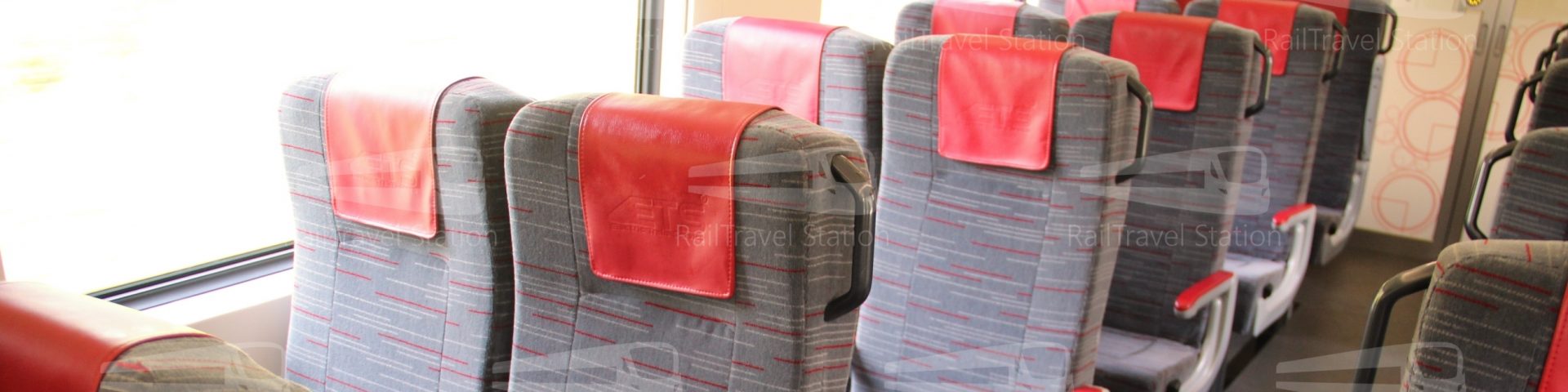
The interior of the Nankai 9000 series EMU.

Longitudinal seats are featured throughout the interior. This is a regular train which can get crowded, but boarding from the first stop at Kansai Airport should get you a seat. Otherwise, just wait for the next train in 15 minutes.


The route map of the Nankai Line and various branches, including the Airport Line.


The on-board information screens are also rotating between Japanese, English, Korean, and Chinese.

My Airport Express departed from Kansai Airport Station at 4.39pm.
This section of track between Kansai Airport and Rinkū Town is also shared by JR West.


Heading up to the Sky Gate Bridge R, also known as the Kansai International Airport Access Bridge.


Crossing the Sky Gate Bridge R from Kankūjima to mainland Japan.


Heading off the Sky Gate Bridge R on to mainland Japan at Rinkū Town.
Rinkū Town Station


Making a brief stop at Rinkū Town Station. Nankai and JR West share the same island platform at Rinkū Town Station which is quite interesting.

The Nankai and JR lines split immediately after departing from Rinkū Town Station.


The JR Kansai Airport Line heads straight on to Hineno to join the Hanwa Line to Osaka.


The Nankai Airport Line turns left to meet the Nankai Main Line.


The flying junction for the Nankai Airport Line over the Nankai Main Line.

More frequent Nankai trains can be seen now.

Arriving at Izumisano.
Izumisano Station


Making a brief stop at Izumisano Station. A lot more passengers boarded here, connecting from a local train from across the platform to speed up their journey with the express.


I was surprised that there were quite a number of level crossings on this highly-used main line.
Kaizuka Station


Making a brief stop at Kaizuka Station.


The Airport Express bypasses minor stations along the route which may be served by Local or Semi-Express trains instead.
Kishiwada Station


Making a brief stop at Kishiwada Station.

Arriving at Haruki Station.
Haruki Station


Making a brief stop at Haruki Station.
Izumiōtsu Station


Making a brief stop at Izumiōtsu Station.

Heading up to the elevated section as the train ride gets closer to the city.
Hagoromo Station


Making a brief stop at Hagoromo Station.
Sakai Station


Making a brief stop at Sakai Station.
Sumiyoshitaisha Station

Making a brief stop at Sumiyoshitaisha Station.
Tengachaya Station

Making a brief stop at Tengachaya Station.
Shin-Imamiya Station

Making a brief stop at Shin-Imamiya Station. Shin-Imamiya is a major interchange station with the JR Osaka Loop Line, JR Kansai Main Line (Yamatoji Line), Osaka Metro Midosuji Line, Osaka Metro Sakaisuji Line, and Hankai Tramway Hankai Line.
Namba Station


My Airport Express arrived at Namba Station on time at 5.25pm, making this a journey of 46 minutes.
It may be worthwhile to note that the Limited Express Rapi:t does not overtake any Airport Express trains, so while the travel time may be longer, if you are in front of a Limited Express Rapi:t, you will get to your destination earlier by the Airport Express anyway instead of waiting for the Limited Express Rapi:t.

The station sign of Namba Station.

Namba Station is the main terminus of the Nankai Electric Railway with end-on platforms.

Heading out to the ticket gates.


Nankai Namba Station is directly connected to Namba CITY, a big shopping complex. For now, I returned to the platform to catch the next train back to Shin-Imamiya where my hotel was located, before coming back to Namba again for dinner. I took the Airport Express all the way to Namba just to ride the train for the whole line.
Conclusion
The Nankai Airport Express is a fast and direct way to travel from Osaka Kansai International Airport to downtown Osaka at Namba. While many would prefer to use the famous Limited Express Rapi:t, the frequency isn’t ideal and tickets can get sold out, which will result in waiting for yet another hour if one insists on taking it or if stuck with a prepaid ticket. The Nankai Airport Express on the other hand uses the same tracks as the Limited Express Rapi:t with just a few more stops, and departs every 15 minutes or so. Seats and luggage storage are basic, but it is also cheaper to travel with the Nankai Airport Express with no additional fees required.