


The full Royal Railway Phnom Penh – Poipet Line has been active since 4 July 2018, but only operated with an average of 1 return trip a week on a weekday. With the timetable change effective 12 July 2019, and trains running on a new weekend timetable with 2 pairs of return trips weekly, it fits perfectly with my Jetstar Asia flight booking, though I had to happily abandon the return portion of it in order to try out this new service.
Poipet is the border town to neighbouring Thailand, and this new train service travels on a historical trans-Cambodian route completed in 1942, which was disrupted by turmoil over civil war and in more recent times, poor track conditions. Train services were finally reinstated in 2018 with ever-developing modernisation of the line.

As Phnom Penh Railway Station would only be most active on a Sunday morning with consecutive train movements and heavier passenger loads, I headed to the station early to spot some trains first, and hopefully get my ticket printed.

The facade of Phnom Penh Railway Station.

The central door was closed during my visit.

Entering the station through the side door.

The new, rather stale waiting hall with the recent furnishing of metal benches, making it look like almost every other railway station in ASEAN.

I enquired about my Easybook ticket at the Royal Railway ticket counter again to see if they were able to issue me a printed or written ticket, but they were unable to as my email is the ticket already, just like a normal Easybook booking in Singapore or Malaysia. Sigh.

Heading to the platform about 30 minutes before departure. Phnom Penh Railway Station consists of a single island bay platform, now supplemented by a side hole in the wall for the Airport Shuttle Train.

The side hole in the wall for the Airport Shuttle Train.

The entrance gate to the platform.

The Royal Railway Phnom Penh – Poipet Line (PNH-PS-BB-SS-PP 07:15 AM) train at Phnom Penh Railway Station as seen from the station car park, operating as a mixed passenger and cargo train.

Heading into the platform through a new, unused ticket gate.

Seems like Royal Railway will implement QR code ticket scanning in future?

Trains to Sihanoukville depart from Platform 2, while trains to Poipet depart from Platform 3. I’m assuming Platform 1 is the hole in the wall for the Airport Shuttle Train.

The rear of the Phnom Penh – Poipet Line (PNH-PS-BB-SS-PP 07:15 AM) train.

A tailboard with a reflector marks the end of the train.


The buffers and chains coupling between the two flat cars.

The Phnom Penh – Sihanoukville Line (PP-TK-KP-SHV_001) train on Platform 3 was made up of a single-car Airport Shuttle Train on the day of my trip.

The Phnom Penh – Sihanoukville Line (PP-TK-KP-SHV_001) train was operated by Mexican DMU AS1003.

Passengers board the Mexican DMU by a set of mobile stairs here too.

Mexican DMU AS1003 at Phnom Penh Railway Station.

A covered goods wagon is attached to transport some small items, along with a generator to supply hotel power to my train.

And here’s my train to Poipet. Looks familiar? It’s the exact same train as the one I took to Sihanoukville last year, except…


… this Waggonfabrik Uerdingen DMU ZZ803 now has a new engine, making it a DMU again instead of just a hauled coach.

The coupling between Coaches A and B.

Looking back at the Phnom Penh skyline from the platform of Phnom Penh Railway Station.


The Phnom Penh – Poipet Line (PNH-PS-BB-SS-PP 07:15 AM) train readied at Platform 2.

More covered goods wagons in the old yellow Royal Railway livery.

Boarding the Waggonfabrik Uerdingen DMU ZZ803 at Coach A.

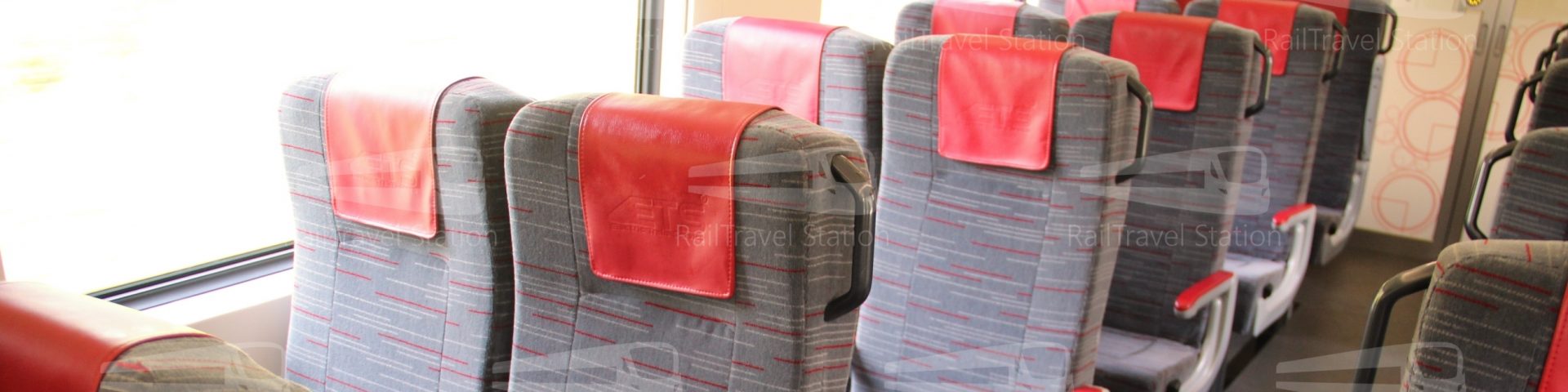
The interior of Coach A.

Coach A is fitted with transverse seats in 2+2 configuration, with seat back being able to flip according to the direction of travel.

As such, bays of 4 seats may also be formed.


The clean and spacious toilet on board Coach A.

The gangway between Coaches A and B, of which the platform is the buffer itself.

The interior of Coach B.

Seats are fixed in bays of 4 seats.

The clean and spacious toilet on board Coach B.

Heading back onto the platform to spot the Phnom Penh – Sihanoukville Line (PP-TK-KP-SHV_001) train departing.


The oldest and newest DMUs in Royal Railway’s fleet, side by side, in front of the Phnom Penh skyline.

Bye bye, Mexican DMU AS1003.

Heading off to Sihanoukville.

Sorry to say that the Mexican DMU looks like a Brio wooden toy train from this angle.

Heading back to my Phnom Penh – Poipet Line (PNH-PS-BB-SS-PP 07:15 AM) train.

The new engine of the Waggonfabrik Uerdingen DMU ZZ803.


Heading back into the seating saloon, there are more passengers on board now.

The legroom on board Coach A as a bay of 4 seats.

The legroom on board Coach A as transverse seats.

The view out of the train car.

The Phnom Penh – Poipet Line (PNH-PS-BB-SS-PP 07:15 AM) train departed at around 7.40am – 25 minutes delayed.

Heading out of Phnom Penh Railway Station through the many points leading to various parallel lines.

I see the cause of the delay now, my Poipet train was waiting for the Airport Shuttle Train to arrive.


Pulling away from Phnom Penh Railway Station.

This Waggonfabrik Uerdingen DMU ZZ803 surprisingly has power to pull the container wagons with no significant issues.

Passing by some maintenance trolleys.

Crossing a modern level crossing.

Heading past some local houses.

Passing by water cranes for steam locomotives in the yard.

Mexican DMU AS1001 resting in the yard, surrounded by the two repainted CRRC Qishuyan locomotives.

The active locomotives resting outside the locomotive shed.

Can’t wait to see what Royal Railway does with this coach.

The side view of the CRRC Qishuyan BB1060 locomotive BB1060.

The repainted CRRC Qishuyan BB1060 and BB1061 locomotives.

Some cut-out containers acting as shelters behind the locomotive shed.

The towering Phnom Penh Megamall/Parkson Mall behind the yard.


Hope to see these coaches refurbished soon.

Another locomotive shed here.

Some YDMs are resting inside this shed, probably waiting for a repaint.


Passing by a disused passenger station in Phnom Penh, but might be used for train crossings.

A rather safe fouling point here.

Approaching the Airport Branch Line.


The junction to the Airport Branch Line.


Arriving at Samrong.


Making a brief stop at Samrong, for the staff to switch the tracks over to the Phnom Penh – Poipet Line.


The on-board crew manually switching the point over to the Phnom Penh – Poipet Line.


Heading over the key junction in Cambodia, splitting the two main lines spanning the country.

Splitting away from the Phnom Penh – Sihanoukville Line, marking a new milestone for myself.

Heading onto the Phnom Penh – Poipet Line.

Passing the very safe fouling point at Samrong Junction.


Continuing ahead.


Once the train has passed the fouling point, it stops again for the train crew to come back on the train.

Surprisingly, the track was still set to Poipet. Hmm, maybe the next train is coming from this direction too.

Once done, the train departs from Samrong Junction.


Some cows resting around Samrong Junction.

Throttling up.


Splitting off from the Phnom Penh – Sihanoukville Line very smoothly.

Some new shophouses along the railway line.

Lots more smoke as the train throttles up to the rather straight line without nearby dangers around the track.

The common rural Khmer scenery as seen from the train.

Splitting off from a main road.

Passing by an oil warehouse.

More Khmer scenery.


Making a brief stop and go at Batdeung. Surprisingly, the train is now on time despite the 25 minute delay from Phnom Penh.

Departing from Batdeung.


Crossing a level crossing after Batdeung and throttling up.

There is a power socket by the air-conditioning unit. As this is going to be a long ride, I decided to test it first if it works.

And it certainly does.

3G and 4G mobile network was also almost fully covered along the railway thanks to the many cell towers located along the railway line.


Passing through Mea Nork without stopping.

As I had booked my Royal Railway ticket through Easybook and flashed my phone at Phnom Penh before boarding, I was unfortunately not able to get a printout of the ticket from the ticket counter, just like most single-departure express buses in Singapore or Malaysia.
Royal Railway Cambodia uses the exact same Easybook system as Singapore and Malaysia express buses, even reflecting the identification number box as NRIC (National Registration Identity Card for Singaporeans) for me, making payment and ticketing seamless and instant.
Hmm, I wish some other Malaysian train company would adopt this too instead of putting a black mark of this useful and almost error-free agent on their own money-taking-ticket-non-issuing website.

Passing through more Khmer scenery.

Approaching a level crossing slowly. Must be approaching a station.

Oh hello, you look very familiar.

Your face seems to have gotten a major filling and touch up though, after rusting up in Gemas, Malaysia for too long. I guess you’re going to be the next to be repainted into the Royal Railway livery. Glad that there’s a train company which appreciates trains better.

Crossing with ex-KTM Berhad YDM 6663 hauling a Tela diesel train waiting in the loop line of Romeas Railway Station.

Remnants of KTM’s keris logo can still be seen, though one side seems to have been touched up from the rusting in Gemas, Malaysia.

The cab and short hood has yet to be touched up.

The YDM4 strangely carries a tailboard at the rear of the locomotive despite obviously not being at the end of the train.

A comparison photo of YDM 6663 at Kluang, Malaysia hauling a shuttle train. The air-conditioning pod seems to have been removed already.


Lots of Tela diesel wagons trail behind.

Making a brief stop at Romeas.

The YDM-hauled Tela train pretty much took up the entire length of the loop line of Romeas.

Both trains departing from Romeas together.


Lots of vast Khmer scenery along the way.

Making a brief stop at Kdol.

The loop line of Kdol.

The driving crew heads down here for a quick run to a local shop.

Hmm, perhaps I should have followed them to buy some local stuff and local prices for the trip. But off the train goes again.

Heading on northwest.

Approaching Bomnak.

Local houses built within Bomnak Railway Station.

Bomnak Railway Station with a local shop within it.

Departing from Bomnak.


More standalone housing along the way.

Crossing a local level crossing with local kids waving the train by.

Crossing a very new truss bridge over the Pursat River. The bridge is so new, it looks almost toy-like with not a single sign of rust.

Crossing over the Pursat River.

Approaching Pursat Railway Station.

The locomotive shed of Pursat.


The second platform of Pursat.

Arriving at Pursat Railway Station.


The train arrived at Pursat at 11.45am – 55 minutes before time. Here, the train takes a long break for lunch.

There is a local stall selling preserved foods with rice down at the platform.


The grilled and preserved dishes on offer.

Bottled drinks are also available, including water and beer.

The renovated facade of Pursat Railway Station.

The next train times as written on the station whiteboard.

The ticket counter of Pursat Railway Station.

The frontage and driveway of Pursat Railway Station.

Once done with buying my lunch, I headed back to the train.

The front of the Waggonfabrik Uerdingen DMU ZZ803 as seen from the platform of Pursat Railway Station.

The Phnom Penh – Poipet Line (PNH-PS-BB-SS-PP 07:15 AM) train at Pursat Railway Station, as seen from across the platform.

The Waggonfabrik Uerdingen DMU ZZ803, now with its own motive power.

For staff, lunch is cooked by the station staff for both the train crew and themselves, so they eat together on this long stop at Pursat. Not bad for staff welfare.

My takeaway lunch from the food stall at Pursat Railway Station. I picked a fish, salted egg, and sausage, with white rice and a free (?) side vegetable mix which the stallholder threw in a bag for me. This costs 6000 Riel or US$1.50 (~S$2.08).

I bought a bottle of Oishi Green Tea Honey Lemon as well, which price I have forgotten.
The dishes were rather salty and oily for my standards, but otherwise, they seem to taste pretty local, so I was okay with that. I had tried similar foods on my previous journey to Sihanoukville and back, so I was kind of expecting it anyway.

Departing from Pursat Railway Station right on time at 12.40pm.

Passing through Beung Khna Railway Station.

Remnants of a godown (?) at Beung Khna.


Continuing on.

Making a brief stop at Maung Russey Railway Station.

The opposite side of the station.

Departing from Maung Russey Railway Station, past a former maintenance shed (?).


More Khmer scenery, reminiscent of my time around the Angkor Archaeological Park. I guess I’m getting close to around that area.

The train crawled to a dead slow, so I headed out to check out what’s happening and I was greeted with this sight.

Turns out that the train is now passing through the famous Battambang Bamboo Train (Norry) starting station, so everyone had to move their Norrys off the track while tourists snap a photo of the real, scheduled train.

Both tourists and locals (I’m assuming tour guides) alike are taking pictures and videos of my train.

A tourist Norry used to ferry people along a tourist route in Battambang, fully furbished with a carpet and cushions.

Regular Norrys look something like this middle one.

Looking back at the Norrys.

The main station is on the right side of the train, with a station sign that can’t be read and not listed in Royal Railway’s timetable. Google Maps just lists it as Bamboo Train Battambang.

Passing by more Norrys at the side of the railway track.

Throttling up after passing through the tourist Battambang Norry station.

Crossing over the Sangker River.


Taking a right curve into Battambang.


Entering Battambang Railway Station.

Looks like Battambang is rather capable of holding trains with 2 loop lines.


A disused maintenance shed (?) on the platform main line.

Approaching Battambang Railway Station.


The train arrived at Battambang at 3.43pm, that’s 37 minutes before scheduled arrival time. Here, all passengers except me alighted from the train.

A Royal Railway Norry in yellow, probably used as a maintenance vehicle in lieu of a trolley.

A disused box car sitting on an active line. I wonder what’s the plan for this.


The ticket counter of Battambang Railway Station.


The colourful facade of Battambang Railway Station with flags.

Only the left side counters are in use.

The station information whiteboard of Battambang Railway Station.

As it was another long stop, I decided to walk around for more pictures of the train.

I see the reason for the long stop now.

Hardworking Royal Railway staff at Battambang are giving my train a good scrub.


The Phnom Penh – Poipet Line (PNH-PS-BB-SS-PP 07:15 AM) train at Phnom Penh Railway Station getting a wash.


There’s quite a significant effort in this train wash as aside from just spraying water, workers also mop down each and every window there is.


Heading back into my train as everyone have alighted at Battambang.

Back in my now-private train.

The train wash continues with the staff smiling and waving at me.

Departing from Battambang after the train wash at 4.00pm – 20 minutes before scheduled departure. Hmm.

Joining back onto the main line.


Taking a left curve out of Battambang.


As everyone from Coach A had alighted, the staff had also tidied up the coach during the stop in Battambang.


There is a separate higher and lower level within Coach A, probably due to the inner fittings of the DMU as this is the motor car.


Continuing on my private train. It was so private that the driver had radio-ed an on-board staff to ask me where I was going. Is this a train or a limousine?

Passing by Thmor Kor Railway Station.

I heard another radio call and the on-board staff scrambling for the doors immediately after. I headed out to see what was going on, and it looks like we are approaching an inland container depot or something.


Yup, something’s definitely going to happen here. Might be related to all the cargo that the train is carrying.

Oh, the train isn’t turning in?


Here, 2 staff got off the train and walked into this factor.

The train continues on slowly. I guess that it’s going to shunt in from the other end.


Approaching the other access track to the factory.


Passing over slowly across the points.

Another staff got off to switch the tracks in. Aha, I was right.


Pushing back into the factory.


Looks like these containers are going to be offloaded. I hope it won’t take long.

Leaving the main line.


The train stopped short of the containers going into the factory proper.

The train staff looks on as a factory staff takes stock of what has been brought in.

Once the factory staff gives the okay, a tractor (yes, you read that right) shunts the container wagons into the factory and all the Royal Railway staff heads back on to the train.

Departing from the unknown factory.


Heading back onto the main line sharply.

The very much shorter train.

Goodbye, Wan Hai containers.

Switching the points back to face the main line.


Departing from the unknown factory. The pick-up speed feels a lot faster now, shows how much stuff there were in the containers earlier.

The sun slowly going down.


Passing through Phnom Touch Railway Station as locals look on.


Passing through the rather big Mongkul Borey Railway Station with 3 lines, though the station building is still in disrepair.


The other side of the station building.

The sky slowly gets darker as evening approaches.


Approaching Serei Saophoan or Sisophon.

Crossing over National Highway 5 which connects Phnom Penh, Battambang, Sisophon and Poipet. But now, you have the train, so you needn’t get a bumpy bus ride on certain days of the week.


Entering Serei Saophoan Railway Station.

Crossing over to the platform line.


Making a brief stop of just about 2 minutes at Serei Saophoan Railway Station.


Departing from Serei Saophoan Railway Station.


As the train turns left for the final stretch to Poipet, the sun was directly in front so it made for some nice sunset photos from the train.
This section between Serei Saophoan and Poipet is also supposedly made up of former Rawang – Ipoh single track alignment tracks, though I’m now not sure of it as the ride is surprisingly smooth and to my knowledge, the track was also rehabilitated before services restarted again last year, so it might also be new rails.

It would probably suck to be the driver on this leg though. Not sure if this Waggonfabrik Uerdingen DMU has sun visors installed in the cab.

The sunset through the tinted windows on the train.


Heading on parallel to the last stretch of National Highway 5, a stretch I had been on on the bus from Siem Reap to Poipet.


The sunset views towards Poipet.

The Phnom Penh – Poipet Line (PNH-PS-BB-SS-PP 07:15 AM) train arrived at Poipet Railway Station at 7.15pm – 35 minutes delayed. I blame the container drop-off for this delay.


The Waggonfabrik Uerdingen DMU at Poipet Railway Station.


After dropping me off, the train moves ahead from the platform to stop for the night.

The SRT-donated Hitachi RHN railcars are sitting on the loop line at Poipet Railway Station.

SRT has gifted 4 Hitachi RHN railcars with driving cabs, without the middle cars. Looks like Royal Railway has the flexibility to run these as separate 2-car sets too.

Both Thailand and Cambodian flags are pasted on the train.

Seems like SRT had prepared a cross-border destination sign for these Hitachi RHN railcars, though it remains to be seen if Royal Railway will operate the train and service as such. 4 cars might be a bit of an overkill for this border crossing. If ran, this would also break Shuttle Tebrau‘s record of the shortest cross-border international train in the world at just 1.025km from Poipet to Ban Klong Luk Border.

The platform of Poipet Railway Station. The wheelchair logo marks a step-free access to the platform edge to the train, avoiding the drain running through the length of the platform. I’m not sure if there will ever be a step-free access to the actual train though.


The exit door out of the platform.

A ticket counter is present at the platform. Hmm, is this for SRT’s use? This would mean that the ticketing system here would be exactly the same as Padang Besar for the Hat Yai – Padang Besar Shuttle Train.

Walking through the future immigration hall. Seems a lot more orderly than the foot crossing which I’m heading to in a few minutes time.

The ticket counter at the main external part of the station for Royal Railway’s use.

The information whiteboard at Poipet Railway Station.

The open-air station hall of Poipet Railway Station.

The door which I have just exited from is labelled as “Departures”. I’m assuming this lane is for trains to Thailand in future.

The royal portraits hung above the station hall.

On the other side of the station hall, a counter is labelled as “Information Counter”, which seems counter-productive since there is already a ticket counter which can do the job. It is currently used presumably for storage. The door on this side of the hall is also labelled as “Arrivals”.

The facade of Poipet Railway Station at night.


The decorated station sign of Poipet Railway Station.

From here, it was a short walk to the Cambodia-Thailand border where I am crossing over immediately to overnight on Thailand’s side, in order to catch the morning train to Bangkok the next day.
Overall, a very pleasant journey with Royal Railway on this new Phnom Penh – Poipet route. The new weekend timetable also helps in trip planning, and I was glad to see more passengers on board than I had expected, though the train still ran empty (with me on board) from Battambang to Poipet. With this new train service, if I am overlanding from Cambodia to Thailand again, this is my definite top choice. With the rapid progress made in Royal Railway, hopefully the next time I use this line, the section between Poipet and Aranyaprathet will be reopened so that trains can finally cross borders again, making it possible for an unbroken train line from Phnom Penh to Bangkok, Hat Yai, Padang Besar, Butterworth, KL Sentral, Gemas, JB Sentral and Woodlands CIQ, thus connecting ASEAN broadly in this modern age.
In the meantime, Royal Railway surely needs more passengers in order to sustain this new and convenient service. I kind of know why the train had to haul containers now because it would be impossible to sustain the service with just 1 passenger heading from Phnom Penh to Poipet, and more income is definitely needed than my US$7. If yo’re heading to Battambang, Sisophon or Poipet from Phnom Penh, ot vice-versa, do use the train for a new and different experience in Cambodia!
I believe the first disused station out was Pochentong (yeah, I didn’t realise either!) Too far for airport passengers though, so I guess that’s why they built the branch line